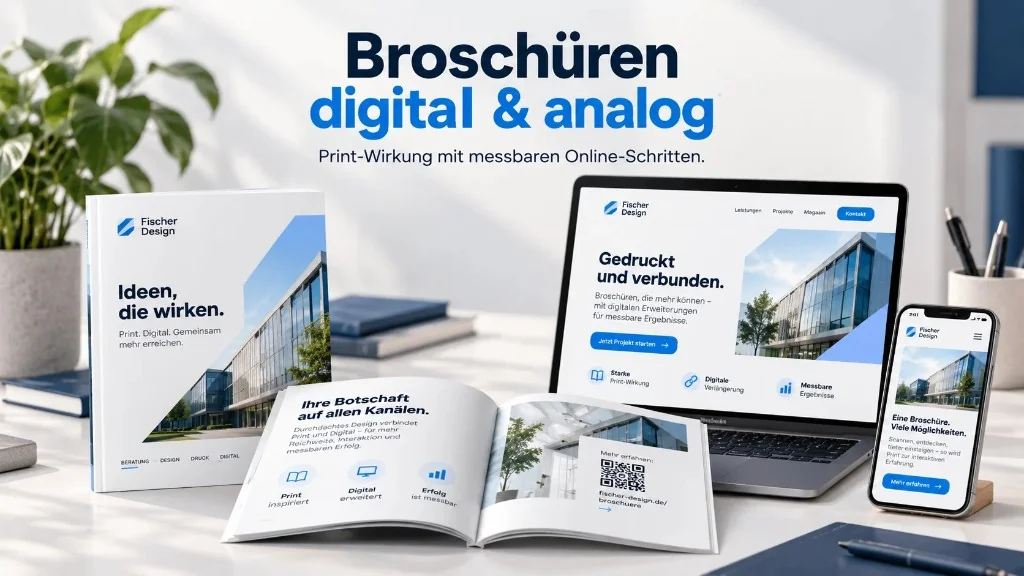
Many companies invest in beautiful brochures – and then lose the thread. No clear next step, no QR to the website, no alignment with brand and online presence. Others ship only a PDF and miss the tangible trust that helps in sales meetings and at trade fairs. Good graphic design treats brochure, brand and website as one system – not three separate jobs.
In this article we explain clearly how brochures convince offline and continue online – and how Fisher Design shapes print so it leads to enquiries. Goal: a brochure people keep – and that also takes visitors to your website and into a conversation.
In short: what “digital and print” means
A brochure works in both worlds when:
- design and message match brand and website
- print files are technically clean
- the online path is clear (QR, short address, path to enquire)
- content leads with benefit – and names the next step
Then print is not an island – it is part of your sales process.
Why brochures still matter in 2026
Paper stays tangible: on the table in a conversation, in a folder at a fair, as a quality leave-behind. At the same time readers expect a digital follow-up – form, video, appointment, deeper page. Connecting both uses the strengths of both channels: attention and trust on paper, measurable steps online.
1. Clarify first – then design
Before layout starts, three things should be clear:
- Who are you speaking to – and in what situation?
- What is the one main benefit on the cover?
- What should happen after reading: request a quote, book a call, download, start a project?
Without that, the brochure becomes a gallery. With clarity it becomes a sales tool – and the online step becomes measurable.
2. Structure: benefit before features
A proven order:
- Cover – benefit promise and brand
- Opening – the audience’s situation
- Services – benefits first, then details
- Proof – references, projects, numbers, team
- Next step – contact, QR, clear action
- Back – contact details, website, social
Direct language, short paragraphs, subheads and lists make reading easier – in print as on a good website.
3. Brand across every channel
Colours, type, logo and image style must match the website and your offers. Otherwise print feels “foreign” and weakens trust. Define:
- colours for print and for screen
- type that stays readable as PDF and on a phone
- an image style people recognise online
More on brand foundations: brand design. Typical logo pitfalls: 7 logo mistakes that weaken brands.
4. Print technique that avoids reprints
Clean print files are essential:
- CMYK instead of RGB – otherwise colours shift
- 300 dpi images at final size
- about 3 mm bleed; keep key elements away from the edge
- embed fonts; black text preferably as solid black
- choose format, paper and finish to fit the brand – feel shapes perception
Small runs often digital; larger runs offset. Have files checked before printing – that saves time and cost.
5. Digital bridges: QR, page, measurement
QR codes and short links connect print to online – but only if the destination is right:
- to a mobile page, contact form, project or video
- large enough, with enough space around it, tested on a phone
- ideally with campaign tracking – so you see scans and enquiries
The destination page should look like the brochure. Otherwise the journey breaks. That is where strong web design pays off – see also why good web design measurably drives more enquiries.
6. PDF for email – not just a shrunk print file
Many brochures get forwarded by email. For that you need:
- readable type and sensible pages on screen
- clickable links and a sensible file size
- optional interactive elements – without breaking the print master
One system, two outputs: print master and screen PDF from the same brand and content base.
Checklist: brochure digital + print
- One clear goal and one clear next step?
- Benefit obvious on the cover?
- Brand consistent with website and offers?
- Print files clean (CMYK, resolution, bleed, fonts)?
- QR or link to the right mobile page – tested?
- Contact details and action impossible to miss?
- PDF ready to email?
- Results measurable (scans, forms, enquiries)?
How we work at Fisher Design
We design brochures as part of your communication: message, layout, print and digital handover – aligned with brand design and website. That turns paper into a path to enquiries, not just a pretty stack on a trade-fair stand.
Request a quote for brochure and brand presence
Takeaway
Brochures that work digitally and in print combine tangible impact with clear online steps: one brand, clean print technique, QR to the website and an action that triggers enquiries. Think print and web separately and you leave reach and results on the table.
Ready for brochures that carry your brand and take visitors further? Talk to Fisher Design – we connect graphic design, brand and web design into one presence.